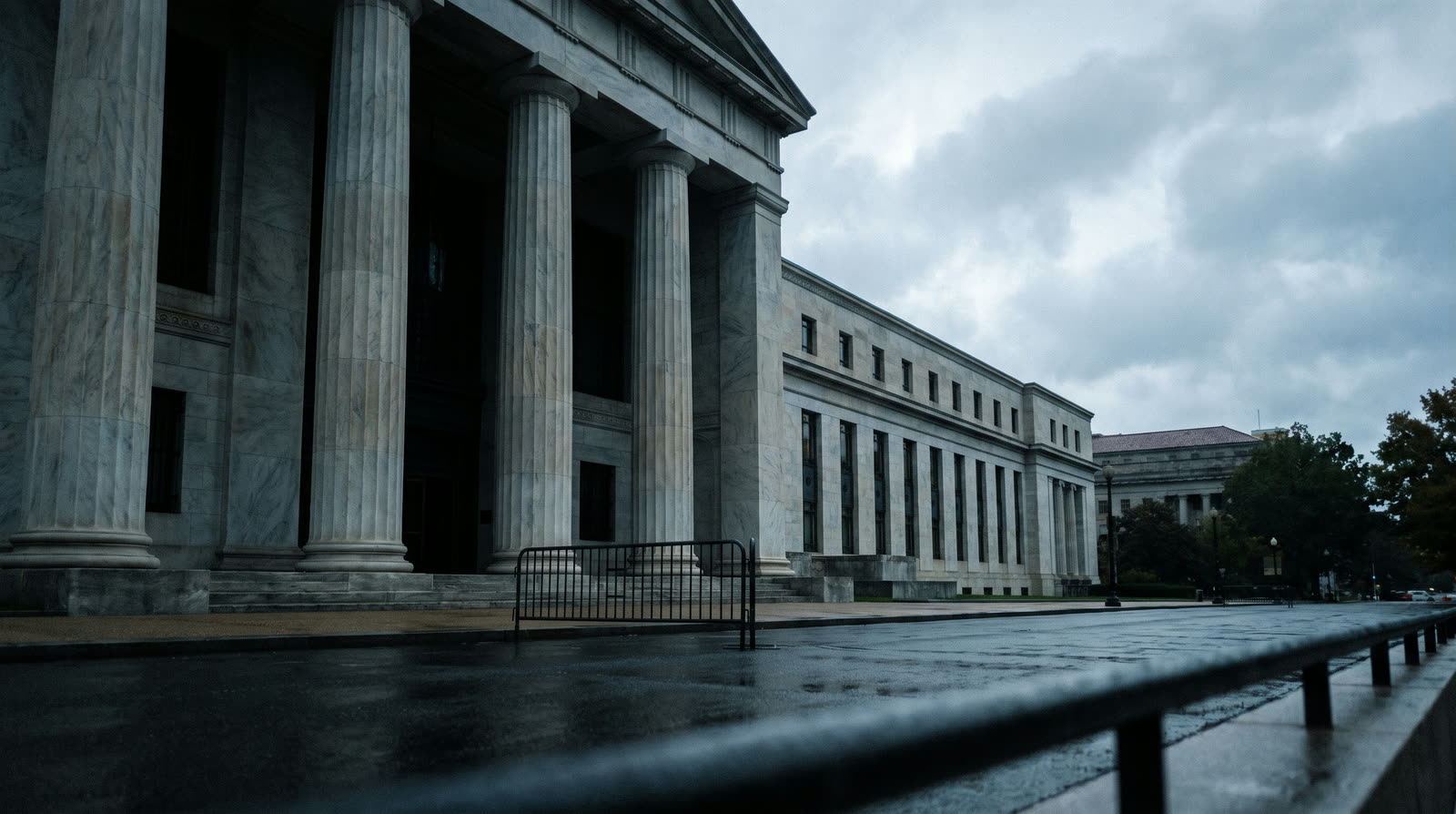
Most people imagine the Federal Reserve as a single entity that decides things. In reality it is a committee of individuals who often disagree, and in 2026 they are disagreeing more openly than usual.
That disagreement has become one of the biggest drivers of day-to-day market movement. Within a single fortnight in late August and early September, two speeches by two officials moved rate expectations by tens of percentage points in opposite directions.
What happened
At the Jackson Hole symposium in August, Fed chair Kevin Warsh delivered a keynote that markets read as firmly hawkish. He said plainly that he was committed to fighting inflation.
The repricing was immediate. Before the speech, traders had put the probability of the Fed simply holding rates in September at close to 70%. Afterwards, the odds of a quarter-point hike rose to around 48% on prediction markets and roughly 56% on fed funds futures.
Then it swung back. Fed governor Christopher Waller said he would support keeping rates unchanged if inflation continues moving toward the 2% target. Hike odds fell to about 50%, down from around 63% the previous day. The bond market, which had sold off, recovered.
Two officials. Two speeches. A market that moved substantially on each.
Why the committee is split
The disagreement is genuine and it is not personal. It reflects a real analytical problem with no obvious answer.
The hawkish case: inflation has been above the 2% target for more than five years. Five years is long enough to damage the credibility of the target itself. If people stop believing 2% is real, expectations drift up and inflation becomes far harder to control. On this view, the risk of doing too little is much greater than the risk of doing too much.
The dovish case: inflation is in fact falling. Headline came in at 3.4% in July, down from 3.5%. Core is at 2.5%, not far from target. Interest rate changes take a year or more to work through the economy fully, so much of the tightening already done has not yet landed. Raising rates now risks damaging an economy that is already slowing for reasons nobody can see yet.
Both arguments are reasonable. That is exactly why the committee is divided, and why the July vote was 9 to 3 with three regional presidents dissenting.
Why dissent matters more than usual
A three-vote dissent is high by historical standards. Fed committees tend toward consensus, partly because unified messaging is itself a policy tool. When the central bank speaks with one voice, markets take the message seriously. When it speaks with several, markets have to guess which voice will prevail.
That guessing is what produces the volatility. Every speech becomes a data point about the internal balance of power, and every data point gets traded.
What this means for how you read the news
A few things follow from this that are genuinely useful.
Not all speakers carry equal weight
The chair matters most. Governors, who sit permanently on the committee, matter more than regional presidents, who rotate in and out of voting. A hawkish comment from a non-voting regional president is interesting; the same comment from the chair is a policy signal.
This is why Warsh's Jackson Hole speech moved the market far more than most Fed commentary does.
Watch what shifts, not what is said
The useful information is rarely the content of a speech in isolation. It is whether an official has changed position. A known hawk saying hawkish things is not news. A previously cautious official turning hawkish is.
The market price is the best summary
Rather than trying to interpret every speech yourself, watch what rate expectations are doing. Fed funds futures and prediction markets aggregate everyone's interpretation into a single number. Our explainer on how Fed rate odds are priced walks through how to read them.
The trading implication
A divided central bank creates a specific market environment, and it helps to name it.
Trends do not persist. When the expected policy path keeps flipping, so does the market. Positions based on "rates are going up" get stopped out when a dovish speech lands, and vice versa. Directional conviction is punished.
Unscheduled events matter. You can plan around a Fed meeting because you know the date. You cannot plan around a governor giving an interview on a Tuesday afternoon. This raises the value of holding smaller positions overnight and reduces the value of tight stops, which simply get triggered by noise.
Ranges widen without direction. This is the most frustrating combination for trend-following approaches: bigger daily moves, no sustained direction. It is also the environment where over-trading does the most damage.
How it gets resolved
Committee splits do not last forever. They get resolved by data.
The 11 September inflation report is the next real test. A hot number strengthens the hawks and probably settles the September argument. A soft number strengthens the doves and takes a hike off the table.
That is worth remembering when you are tempted to trade the speeches. The speeches are officials arguing about what the data will show. The data itself is what actually decides it.
The takeaway
A divided Fed is not a sign of dysfunction. It is what you would expect when the economic evidence genuinely points in two directions at once, which it currently does.
For markets, though, it means something practical: expectations are unstable, individual speeches carry outsized weight, and anyone holding a strong directional view is exposed to a single unscheduled comment from someone whose diary they do not have.
Trade the environment you are in rather than the one you would prefer. Right now, that means respecting the fact that nobody - including the people making the decision - is certain what happens next.
Who actually sits on the committee
Understanding the structure explains why some voices carry further than others.
The rate-setting committee combines two groups. The Board of Governors is a small group based in Washington, appointed for long terms. All of them vote at every meeting. The chair leads this group.
The regional Federal Reserve Bank presidents head the twelve district banks around the country. One of them votes permanently; the others rotate through voting positions on a schedule.
This matters when you read the news. A regional president giving a hawkish interview may not have a vote this year. Their comments still carry information, because they reflect the internal debate and the research their bank is producing, but they do not directly change the arithmetic of the decision.
The July vote of 9 to 3, with three regional presidents dissenting, is unusual precisely because dissent from voting members is discouraged by convention. Officials who disagree usually express it in speeches rather than votes. Three formal dissents indicates a disagreement strong enough that the usual convention broke down.
How to follow this without drowning in it
There is far more Fed commentary than any individual can usefully process. A few filters help.
- Prioritise by seniority. The chair, then the vice chair, then governors, then voting regional presidents, then everyone else. Most commentary from the bottom of that list can be safely skipped.
- Prioritise prepared remarks over interviews. A written speech has been considered and approved. An off-the-cuff answer may be a slip rather than a signal, though markets sometimes trade it anyway.
- Watch the minutes. Published a few weeks after each meeting, they reveal the shape of the internal argument, including how many officials held which view.
- Note the blackout period. Officials stop speaking publicly for about a week and a half before each meeting. If you are waiting for clarity in that window, it is not coming.
That last point is often forgotten and has a practical consequence. In the run-up to a decision, the flow of new information dries up, so the market trades on data alone. It is a period where positioning matters more than news.
What a policy mistake looks like
Both sides of the current argument are, in essence, worried about a specific error.
The hawks fear doing too little. In that scenario, inflation settles at a level above target, expectations adjust upward, and the eventual correction requires much higher rates and a genuine recession. This is the historical failure that central bankers are trained to fear most, because the cure becomes far more painful the longer it is delayed.
The doves fear doing too much. Interest rate changes act with long and variable lags, often a year or more. Tightening into an economy that is already slowing for reasons not yet visible in the data can turn a soft landing into a hard one. By the time the damage appears in the statistics, it is too late to undo.
Neither error is obviously worse in the abstract. Which one you weight more heavily depends on your reading of the current evidence, and reasonable people are reading it differently.
For markets, the uncomfortable truth is that a mistake in either direction is only identifiable in hindsight. That is why the argument cannot be settled by debate, and why the data releases matter so much more than the speeches.
This article is general information, not financial advice. Do your own research or speak to a licensed professional before making money decisions.
General information, not advice. This article is published to everyone who reads it and takes no account of your circumstances, so it is not a personal recommendation. Trader Suite is not authorised or regulated by the FCA. Trading and investing involve a substantial risk of loss, and you should seek independent advice before acting. Our articles are researched and drafted with AI assistance and reviewed before publishing. Full risk disclosure.
TraderSuite Team
TraderSuite builds indicators and automated strategies for NinjaTrader 8. Our articles are written by the team, researched and drafted with AI assistance, and reviewed before publishing.