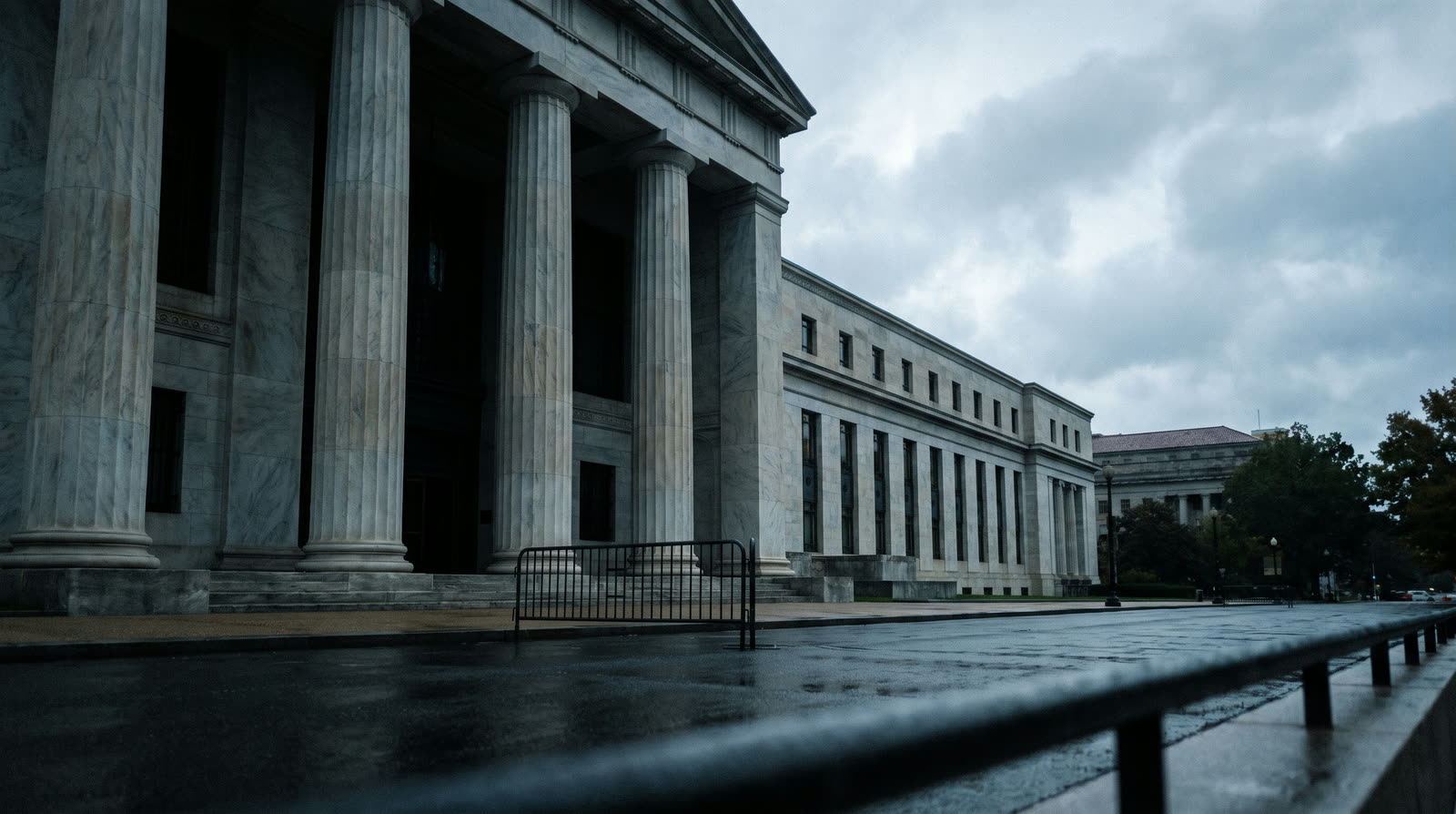
It is rare for a Federal Reserve meeting to be a genuine coin flip. Usually, by the time the meeting arrives, the market has made up its mind and the only question is what the Fed says afterwards. September 2026 is different. As things stand in the first week of the month, traders are split almost exactly down the middle on whether the Fed raises interest rates or leaves them alone.
That uncertainty matters to you whether you trade for a living or just have a mortgage and a savings account. This article explains what the Fed is actually deciding, why the decision is so finely balanced, and what each outcome would mean in practice.
What the Fed is deciding
The Federal Reserve is the central bank of the United States. Its main tool is the federal funds rate, which is the interest rate banks charge each other for very short-term loans. It sounds technical and far away from ordinary life, but it is the anchor for almost every other interest rate in the economy. Move it, and mortgages, car loans, credit cards, business loans and savings accounts all tend to follow.
Right now that rate sits in a range of 3.50% to 3.75%. The question in September is whether it stays there, goes up by a quarter of a percentage point, or, as a small minority still hope, comes down.
Why this decision is so close
The Fed has a problem it has not been able to shake. Inflation, which is the rate at which prices rise, has now been above the Fed's 2% target for more than five years. The most recent reading, for July 2026, put annual inflation at 3.4%. That was down slightly from 3.5% the month before, and the core measure, which strips out food and energy because those bounce around, came in at 2.5%.
So inflation is drifting in the right direction. It is just doing it very slowly, and it has been above target for so long that patience inside the Fed has worn thin.
At the July meeting the committee voted 9 to 3 to hold rates where they were. Three regional Fed presidents dissented, wanting to move. A three-vote dissent is unusual. It tells you the committee is not comfortable, and that a meaningful group thinks the current setting is too loose given how sticky inflation has been.
The Warsh factor
Then came the annual central banking gathering at Jackson Hole in August. Fed chair Kevin Warsh used his keynote speech to state plainly that he is committed to getting inflation back to target. He did not promise a hike. But the tone was firm enough that the market immediately repriced.
Before that speech, traders had put the odds of the Fed simply holding in September at close to 70%. Afterwards, the odds of a quarter-point hike jumped to roughly 48% on one prediction platform and around 56% on fed funds futures. In other words, the market went from expecting nothing to happen to treating a hike as a genuine possibility.
It has not been a one-way move since. When Fed governor Christopher Waller said he would be comfortable holding rates if inflation keeps moving toward 2%, the odds slipped back toward 50% from about 63% the day before. That is the whole story in miniature: the committee is split, the speeches pull in opposite directions, and the market swings with each one.
What a hike would mean
If the Fed does raise by a quarter point, here is roughly what to expect.
Borrowing gets dearer. Anything tied to a floating rate reprices quickly. Credit cards, personal loans and business overdrafts feel it within a billing cycle or two. Fixed mortgage rates are driven more by longer-term bond yields than by the Fed directly, but they tend to drift with the mood.
Savers get paid more. This is the flip side that often gets forgotten. Higher policy rates eventually feed into savings accounts, money market funds and short-dated government bills. Cash stops being dead money.
Shares usually wobble first, then decide. Higher rates make future company profits worth less in today's money, which is a headwind for shares, especially fast-growing ones with profits far in the future. But the size of the first move often has more to do with how surprised the market was than with the economics.
The dollar tends to firm up. Higher rates make holding dollars more rewarding, which usually supports the currency against others.
What a hold would mean
A hold is not automatically good news for markets, and this is the part people get wrong. It depends entirely on the message that comes with it.
A hold with a soft, relaxed statement would probably be taken well. A hold with a hard warning that a hike is coming later, sometimes called a hawkish pause, can hit markets almost as hard as an actual hike, because it removes the hope of relief without removing the threat.
This is why experienced traders pay as much attention to the wording and the press conference as to the number itself.
The dates that matter
Two dates dominate the calendar this month.
- 11 September - the August inflation report is published at 8:30am Eastern. This lands before the Fed meets, and it is the single biggest input into the decision. A hot number makes a hike far more likely. A soft one probably settles the argument the other way.
- The September FOMC meeting itself - the decision, the updated projections and the press conference all arrive together.
If you want to understand how to read the inflation release properly on the day, we have a separate walkthrough on reading the CPI report line by line.
What to actually do about it
Here is the honest answer: do not try to guess the outcome. When the market itself is at 50/50, you have no edge in picking a side, and a coin flip is a terrible thing to bet your account on.
What you can control is your exposure. That means:
- Smaller size around the event. The move after a genuinely uncertain decision is often larger than usual, because half the market is offside whichever way it goes.
- Know your risk before the release, not after. Spreads widen and fills get worse in the seconds around an announcement. Decide where you are wrong beforehand.
- Do not chase the first candle. The initial move after a Fed decision reverses often enough that fading your own impulse is usually the better habit.
- Have a plan for both outcomes. Writing down what you will do if they hike, and what you will do if they hold, takes ten minutes and removes the panic.
If you want a fuller framework for handling this kind of week, our guide to building a rules-based plan for Fed weeks covers it step by step.
The bigger picture
Step back from the single meeting and the situation is simpler than the noise suggests. Inflation has been too high for a long time, it is falling but only slowly, the economy has not rolled over, and a central bank that cares about its credibility is running out of patience.
Whether the extra quarter point arrives this month or in a couple of months matters enormously for the next few trading sessions and surprisingly little for the next few years. The direction of travel has been clear for a while: money is not going back to being nearly free any time soon.
Plan for that world rather than trying to time the exact moment it is confirmed. Pay down expensive floating-rate debt. Take advantage of the fact that cash finally earns something. And if you trade, respect the calendar, because scheduled events with genuinely uncertain outcomes are where accounts get damaged fastest.
The forecasts published alongside the decision
One detail that often gets overlooked: at certain meetings, the Fed publishes a set of economic projections alongside the rate decision. These include where officials expect growth, unemployment, inflation and interest rates to be in the coming years.
The most watched part is the chart of individual rate forecasts, informally called the dot plot. Each dot represents one official's view of where rates should sit at the end of a given year. Nobody is named, so you see the spread of opinion without knowing who holds which view.
In a meeting as finely balanced as this one, the projections can matter more than the decision. A hold accompanied by a set of dots that shifts upward tells you a hike is merely delayed rather than avoided. A hike accompanied by dots suggesting it is the last one is a very different message from a hike with more to come.
This is why markets sometimes move violently in the opposite direction to the headline decision. The number is the past; the projections are the future. If you want to understand how to read that chart properly, we cover it in how to read the Fed dot plot.
Why coin-flip meetings behave differently
There is a structural reason genuinely uncertain meetings produce outsized moves, and it is worth understanding because it explains the risk.
When the market is 90% confident of an outcome, most participants are already positioned for it. The decision arrives, it matches expectations, and very little changes. Even when the unlikely outcome happens, only a minority of positions need adjusting.
When the market is split 50/50, roughly half of all positioning is wrong the instant the announcement lands. Those positions have to be unwound quickly, and everybody tries to do it at the same moment. That is what produces the sharp, sometimes disorderly moves in the minutes after a close call.
It also explains why the move often overshoots and then partially retraces. The initial surge is forced position-closing rather than considered opinion. The considered opinion arrives later, once the statement has been read and the press conference has been heard.
Practically, this means the first few minutes after a coin-flip decision are the worst possible time to form a view. Spreads are wide, liquidity is thin, and the price is being set by people who have to trade rather than people who want to. Waiting is not a missed opportunity. It is usually the better trade.
What would settle the argument
Between now and the decision, a small number of things could tip the balance decisively.
- A hot August inflation report. If the core figure accelerates, the hawks have their evidence and the argument is largely over.
- A soft inflation report. Confirmation that prices are still cooling would strengthen the case for patience considerably.
- A further oil spike. Energy feeding into expectations makes it harder for officials to argue that inflation is under control, even if they should technically look through it.
- Signs of labour market cracking. Any evidence that hiring is deteriorating quickly would shift the committee's focus from prices to jobs almost overnight.
None of these is knowable in advance, which is rather the point. When the people making the decision do not yet know what they will do, the honest position for everyone else is that they do not know either.
This article is general information, not financial advice. Do your own research or speak to a licensed professional before making money decisions.
General information, not advice. This article is published to everyone who reads it and takes no account of your circumstances, so it is not a personal recommendation. Trader Suite is not authorised or regulated by the FCA. Trading and investing involve a substantial risk of loss, and you should seek independent advice before acting. Our articles are researched and drafted with AI assistance and reviewed before publishing. Full risk disclosure.
TraderSuite Team
TraderSuite builds indicators and automated strategies for NinjaTrader 8. Our articles are written by the team, researched and drafted with AI assistance, and reviewed before publishing.