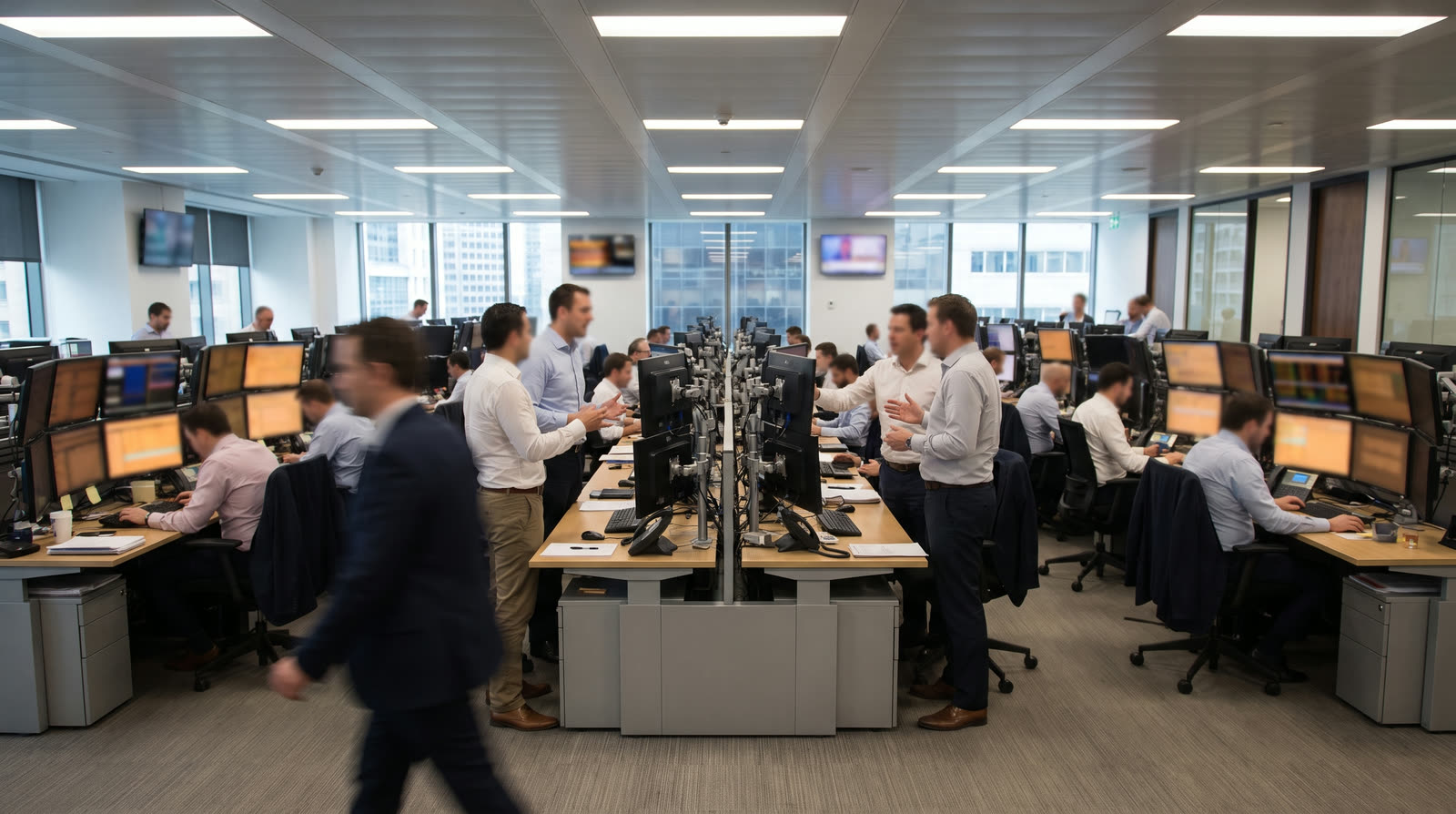
An index is supposed to smooth things out. That is the point of it. When you trade a contract based on hundreds of companies, the individual quirks of any one business are meant to average away, leaving something that reflects the broader economy.
In 2026 that is not quite what is happening. The S&P 500 is up around 7.7% on the year, driven substantially by an enormous wave of capital spending on artificial intelligence infrastructure. That spending is concentrated in a relatively small number of very large companies, and it has made the major indices behave less like a broad average and more like a single theme with extra names attached.
For anyone trading index futures, that changes several practical things.
Why concentration happens
The major US indices are weighted by company size. A business worth a trillion dollars carries far more influence than one worth ten billion, even though both count as one constituent.
When a handful of companies grow to represent a large share of total index value, their price movements dominate. The remaining hundreds of companies can collectively move the index far less than a couple of the largest can on their own.
This is not a flaw in the index design. It reflects genuine economic reality. But it does mean that a contract advertised as broad exposure can be considerably narrower than it appears.
What changes for a futures trader
Single-company news moves the index
Historically, index futures responded mainly to macroeconomic data and central bank policy. Increasingly they also respond to individual company events: an earnings report, a capital spending announcement, a supply chain update, a product delay.
This means your economic calendar is now incomplete. Company reporting dates for the largest constituents matter as much as some data releases, and they are not on most macro calendars.
Volatility arrives in clusters
Rather than being spread evenly, movement concentrates around a smaller number of scheduled moments. Long quiet stretches punctuated by sharp events is a harder pattern to trade than steady daily movement, because the quiet periods lull you into sizing that the busy periods punish.
Diversification within the index falls apart under stress
On calm days, the constituents move somewhat independently. When the dominant theme is questioned, everything connected to it falls together. Semiconductors, cloud providers, power suppliers, data centre builders and networking companies all react to the same news.
The diversification you thought you owned disappears at the exact moment you need it. This is a general property of concentrated markets and it is worth internalising.
The macro link runs through valuation
There is a second channel connecting these companies to the interest rate outlook. High-growth businesses derive much of their value from profits expected far in the future, and future profits are discounted using rates anchored to the ten-year Treasury yield - currently around 4.78%.
When yields rise, these companies fall harder than the broad market. So the index is simultaneously exposed to a specific industrial theme and unusually sensitive to bond yields. On a day when both move the same way, the effect compounds.
Practical adjustments
Know what you are actually trading. Look at the largest constituents of your index and their approximate weights. If you cannot name the handful of companies driving most of the movement, you are trading something you have not examined.
Add company events to your calendar. Earnings dates for the largest names, and major industry conferences where capital spending plans are discussed.
Watch the semiconductor complex as a leading indicator. Chip-related companies sit near the front of the spending chain and often move before the wider index reacts.
Compare the equal-weighted version. Some indices publish a version where every company counts the same. Comparing it with the standard version shows whether a move is broad or driven by a few names. A rally in the standard index with the equal-weighted version flat tells you the participation is narrow.
Respect the overnight session. Company announcements frequently land outside regular hours. Index futures trade nearly around the clock and will have moved substantially before the cash market opens.
The two-sided nature of a theme
It is worth being even-handed here. Concentration is not automatically bad for a trader.
A market dominated by one clear driver is, in some ways, easier to understand. There is a single question that explains most of the movement: is the spending story intact or not? That is a more tractable question than trying to synthesise hundreds of independent business stories.
Trends can also persist longer in concentrated markets, because flows concentrate too. Money moving into the theme buys the same names, reinforcing the direction.
The cost is that when it turns, it turns quickly and without much warning, and hedges built on historical correlations often fail.
How you would spot a change of pace
Since the risk is a change in the rate of spending rather than a halt, the early signals appear in specific places.
- Capital spending guidance from the largest buyers. A smaller-than-expected increase is enough to reprice the sector.
- Order backlogs at equipment suppliers further up the chain.
- Lead times shortening, which signals that shortages are easing and pricing power is fading.
- Power and grid constraints, which have become a genuine bottleneck on how quickly capacity can be added.
- Financing conditions for smaller operators, who borrow at rates anchored near 4.78% and drop out first.
A note on position sizing
Concentration has a direct sizing implication that is easy to miss.
If you hold an index futures position and also hold individual technology shares, you may have far more exposure to the same theme than you realise. The index position is not a diversifier against the individual holdings; it is more of the same trade.
Adding up total exposure to a single driver, across every position you hold, is a useful exercise. Many traders discover their portfolio is considerably less varied than their list of holdings suggests.
For the general arithmetic of sizing in changing conditions, see position sizing when the market speeds up.
The summary
The major indices in 2026 are less diversified than their names imply. A large share of movement comes from a small group of companies tied to one spending theme, and those companies are also the most sensitive to bond yields.
That does not make the market untradeable. It makes it a different instrument from the one many traders think they are trading. Knowing which companies actually drive your contract, tracking their event calendar, and being honest about how much of your total exposure depends on one story are all straightforward adjustments.
The traders who get caught are usually not the ones who were wrong about the theme. They are the ones who believed they were diversified.
Breadth: the number that tells you if a rally is real
One concept deserves a section of its own, because it is the most useful diagnostic available for a concentrated market.
Breadth measures how many companies are participating in a move. A rally where most constituents rise is broad. A rally where the index climbs while most constituents fall is narrow.
Simple ways to check it:
- Advancing versus declining companies. Published daily. If the index is up while more companies fell than rose, a small number of large names did all the work.
- Equal-weighted versus standard index. If the standard version is outperforming its equal-weighted twin over weeks, leadership is narrowing.
- New highs versus new lows. A market making new highs on the index while few individual companies do the same is running on a thin engine.
Narrow leadership is not automatically a sell signal. Narrow markets have persisted for a long time and produced substantial gains. What narrowness does tell you is that the market has become fragile - dependent on fewer things going right, and therefore more sensitive to any one of them going wrong.
That is a risk management input rather than a directional one. It should influence how much you have on, not which way you face.
Trading the theme directly versus through the index
Given that the index has become a proxy for a theme, a reasonable question is whether to trade the theme directly instead.
Both have trade-offs worth knowing.
Index futures offer deep liquidity, near-continuous trading, tight spreads and no single-company disaster risk. But you get diluted exposure: hundreds of unrelated companies pull against the theme, and a great call on the sector can be muted by unrelated weakness elsewhere.
Individual companies or sector products give purer exposure and larger moves. They also carry company-specific risk - a management change, an accounting problem, a lost contract - that has nothing to do with your thesis and can destroy a position that was analytically correct.
For most traders the index remains the more practical instrument, principally because of liquidity and the absence of overnight earnings risk on a single name. The dilution is a genuine cost, but it is a known and stable one, which is easier to manage than an unknown and occasional one.
What to do if the theme wobbles
Rather than trying to predict the turn, it is worth deciding in advance how you would respond to one.
The characteristic pattern when a dominant theme is questioned is a sharp, broad decline in everything connected to it, followed by heavy dispersion as the market separates businesses with real earnings from those trading on expectation.
The first phase is not a good time to be selective, because everything falls together regardless of quality. The second phase is where analysis matters.
Practically, that argues for reducing overall exposure quickly if the theme breaks, rather than trying to pick which parts of it will hold up. The picking becomes worthwhile later, once the indiscriminate selling has finished. Traders who invert that order - staying fully exposed while trying to select winners during the panic - tend to get the worst of both.
This article is general information, not financial advice. Trading futures involves substantial risk of loss. Do your own research or speak to a licensed professional before making money decisions.
General information, not advice. This article is published to everyone who reads it and takes no account of your circumstances, so it is not a personal recommendation. Trader Suite is not authorised or regulated by the FCA. Trading and investing involve a substantial risk of loss, and you should seek independent advice before acting. Our articles are researched and drafted with AI assistance and reviewed before publishing. Full risk disclosure.
TraderSuite Team
TraderSuite builds indicators and automated strategies for NinjaTrader 8. Our articles are written by the team, researched and drafted with AI assistance, and reviewed before publishing.