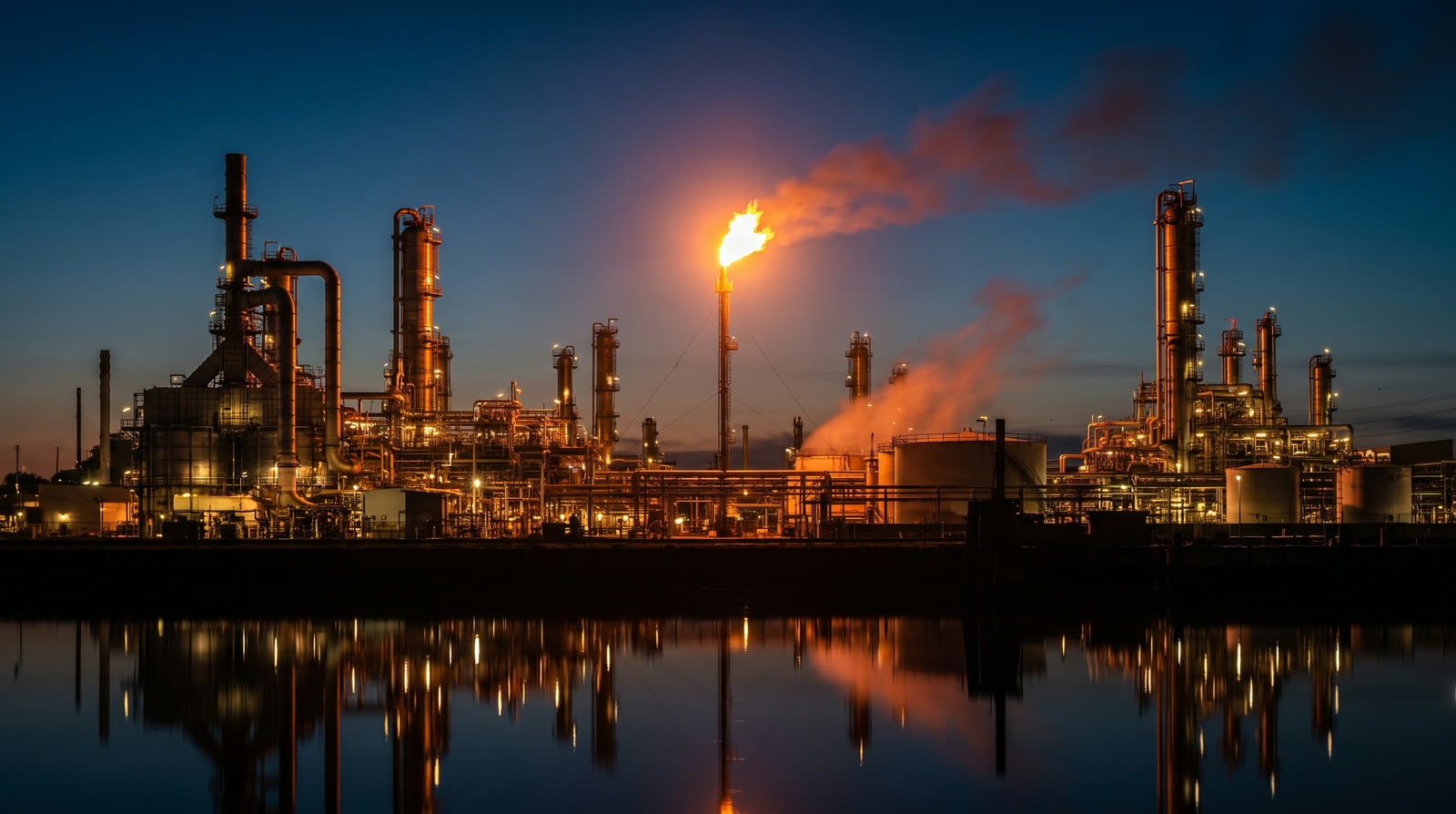
There is a type of market that defeats most trading approaches, and the oil complex in September 2026 is a textbook example of it.
Crude rose nearly 9% in a week to around $91 a barrel. The cause was not a change in demand or a shift in inventories. It was renewed US-Iran strikes and worries about the Strait of Hormuz - events that arrive without a schedule and cannot be anticipated from a chart.
This article is about how to operate in that environment without pretending you can predict the news.
Why charts have limits here
Technical analysis works by assuming that price action reflects the accumulated decisions of participants, and that patterns in those decisions repeat.
That assumption holds reasonably well when information arrives gradually. It breaks when a single external event delivers a large amount of new information at once.
A support level that would have held under normal conditions is irrelevant to a market repricing a supply disruption. The level was never a physical barrier; it was a summary of previous opinion, and previous opinion has just been made obsolete.
What still works
This does not mean abandoning your process. Several things retain value.
Levels still matter between events. Markets spend most of their time not reacting to headlines, and during those periods structure works normally.
Levels matter after the event too. Once a repricing has happened, the new range establishes its own structure, often quickly.
Risk management works always. It is the only part of a trading approach that does not depend on conditions.
What stops working is the assumption that the chart contains information about what happens next when the next input is external.
Rule one: size for the gap, not the stop
In a headline-driven market, the binding constraint is not your stop distance. It is how far the market can move before you get a chance to act.
Since these events occur overnight and at weekends, a stop may execute a long way from where it sits. The only reliable control is position size.
Ask what a 3% adverse gap would cost on your current position. If that figure is unacceptable, reduce until it is not.
Rule two: separate session risk from overnight risk
Many traders use one position size for everything. In this environment it makes sense to run two.
A full size during hours you are watching, when you can respond to developments. A substantially smaller size when you are not. Some traders go flat entirely over weekends during periods of active tension.
The rule should be written down in advance, because the decision made at 10pm on a Friday while holding a profitable position is not the decision you would make calmly.
Rule three: do not fade the first move
The instinct when a market gaps is that it has overreacted and will retrace. Sometimes true, often expensive.
A genuine repricing does not retrace. It establishes a new level and trades from there. Fading a real supply shock means standing in front of a market that is still discovering where it belongs.
Waiting for evidence that the move has exhausted itself - a failed attempt to extend, a range forming - costs you the first portion and removes the worst outcome.
Rule four: know which markets are exposed
Oil is not a contained story. A crude move feeds into inflation expectations, which feeds into bonds, which feeds into equities and currencies.
The early September sequence showed this clearly: bonds sold off partly on the oil surge, pushing the ten-year yield toward three-year highs near 4.78%, which pressured equity valuations.
If you trade index futures and think oil is somebody else's problem, you are exposed to it without monitoring it.
Rule five: track the mechanism, not the narrative
Commentary about geopolitics is plentiful and mostly useless for trading. What helps is watching things that reflect actual risk rather than opinion about it.
- Shipping traffic and insurance rates in the affected region. These respond to real assessments of danger.
- Export volumes from producers. Iraq's exports rose in August and were expected to increase further, which is genuine information about supply.
- Refinery status. Damaged capacity in the Middle East and Russia affects fuel prices independently of crude.
- The shape of the futures curve. Whether near-dated contracts trade above later ones tells you about immediate scarcity.
Rule six: expect the premium to drain slowly
Geopolitical risk premiums build fast and unwind slowly. That asymmetry matters for how you hold positions.
If tension eases without any supply actually being lost, the elevated price tends to decay gradually over weeks rather than dropping at once. Traders positioned for a sharp reversal often give up before it completes.
Conversely, an escalation can add to the premium violently and immediately.
Rule seven: reduce your holding period
The longer a position is open, the more chances there are for an unscheduled event to hit it.
Shortening holding periods is not about being nervous. It is a direct reduction in exposure to a risk you cannot forecast or hedge. In a headline-driven period, taking profits earlier and re-entering is frequently better than holding for a larger target.
Rule eight: keep capacity in reserve
The moments after a major repricing often present the clearest opportunities of the month. Once the initial move is complete and a range establishes, the structure is fresh and the direction is frequently more sustained.
Only traders who have not been damaged during the volatile phase are in a position to take those trades. Preserving capacity is not caution for its own sake; it is what allows you to participate when the market becomes readable.
The mindset that helps
The hardest adjustment is accepting that a meaningful part of what happens next is genuinely unknowable, and that this is not a gap in your analysis to be filled with more effort.
No amount of chart study will tell you whether a shipping lane stays open. No indicator anticipates a diplomatic development. Traders who keep searching for the analysis that would have predicted the last headline usually end up over-trading, because they are trying to solve an unsolvable problem.
The productive response is to shift attention from prediction to preparation: smaller size, shorter holds, defined responses, and a clear head about which part of the outcome you actually control.
The summary
A headline-driven market does not reward better forecasting, because the inputs are not forecastable. It rewards better positioning.
Size for gaps rather than stops. Split session and overnight exposure deliberately. Let repricings complete before taking a view. Watch the mechanisms rather than the commentary. And keep enough capacity intact to trade the clearer conditions that follow.
None of that requires knowing what happens in the Middle East. That is the point.
Distinguishing noise headlines from real ones
Not every geopolitical headline matters, and learning to tell them apart saves a great deal of unnecessary reaction.
Headlines that rarely move markets durably include statements of intent, diplomatic warnings, and analyst speculation about what might happen. These produce brief spikes that fade, because nothing about actual supply changed.
Headlines that do matter involve physical facts: a facility damaged, a shipping route closed, a tanker attacked, production halted, or export volumes changing. These alter the supply arithmetic rather than the mood.
The test is simple. Ask whether the news changes how many barrels reach the market. If it does not, the move it causes is usually temporary.
Applying this filter consistently prevents most of the whipsaw damage that headline-driven markets inflict on active traders.
The problem with reacting at all
There is a deeper issue worth confronting. By the time you read a headline, it is already in the price.
News reaches automated systems and professional desks before it reaches consumer news services. The move happens in seconds. A retail trader reading about it and acting is, by construction, trading after the information has been absorbed.
This means reacting to headlines is structurally disadvantaged. You are not trading the news; you are trading the aftermath of everyone else trading the news, without knowing whether the initial move over-reacted or under-reacted.
The productive alternative is to use headlines as context for understanding why conditions are what they are, and then to trade the structure that develops afterwards, where your disadvantage is far smaller.
Managing an existing position when news breaks
Separate from initiating trades, there is the question of what to do when you already hold something and a headline lands.
The instinct is to make an immediate decision, usually while the price is moving fastest and spreads are widest. That is the worst moment to choose.
A better default is a pre-decided rule. Something like: if a major headline moves the market beyond a defined threshold, reduce the position by a set proportion regardless of direction, then reassess once conditions settle.
This is not optimal in any single instance. It is robust across many instances, and it removes the need to make a good decision under the worst possible conditions.
Why volatility itself is tradeable information
One useful reframing: in a headline-driven market, the level of volatility tells you something even when the direction does not.
Expanding ranges indicate genuine uncertainty and active repricing. Contracting ranges after a spike suggest the market has settled on a new level and the immediate risk has been absorbed.
Watching that pattern helps you judge when to resume normal activity. A market that has stopped making violent moves has usually finished digesting the event, even if the underlying situation is unresolved.
That is a more reliable signal to act on than any assessment of the geopolitics itself, and it is available to anyone watching a chart.
This article is general information, not financial advice. Trading futures and commodities involves substantial risk of loss. Do your own research or speak to a licensed professional before making money decisions.
General information, not advice. This article is published to everyone who reads it and takes no account of your circumstances, so it is not a personal recommendation. Trader Suite is not authorised or regulated by the FCA. Trading and investing involve a substantial risk of loss, and you should seek independent advice before acting. Our articles are researched and drafted with AI assistance and reviewed before publishing. Full risk disclosure.
TraderSuite Team
TraderSuite builds indicators and automated strategies for NinjaTrader 8. Our articles are written by the team, researched and drafted with AI assistance, and reviewed before publishing.